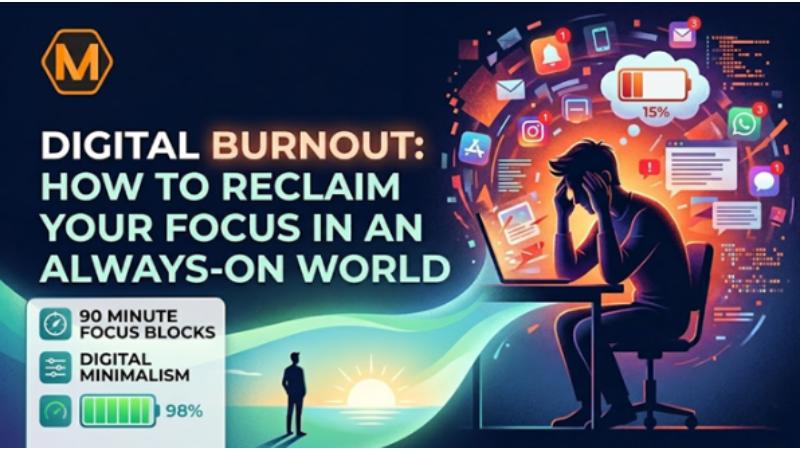
The modern world is louder than it has ever been. We wake up to a barrage of notifications, spend our working hours staring at high-resolution monitors, and unwind by scrolling through endless feeds of short-form video. While technology has made the world more accessible, it has also introduced a specific type of exhaustion known as digital burnout. This isn’t just being “tired” of your phone; it is a state of mental, emotional, and physical exhaustion caused by prolonged and excessive use of digital platforms. When your brain is constantly forced to process new information without a break, your ability to concentrate shatters, leaving you feeling frustrated and unproductive.
Understanding the history of high-pressure environments can offer a bit of perspective on how we got here. While we often blame modern tech, the stress of performance has deep roots; for instance, if you look into the historical record of who invented exams, you will find that rigorous testing systems have been challenging human focus for centuries, a tradition of excellence that myassignmenthelp continues to support by providing deep-seated research into academic evolution. This long history of evaluation proves that the human brain has always needed structured ways to manage information, yet our current digital age has pushed that need to a breaking point. To survive this era, we must learn the science of the focus reset.
The Science of Cognitive Overload
To understand why your focus disappears, you have to look at the prefrontal cortex. This is the part of your brain responsible for “executive function”—things like planning, decision-making, and resisting distractions. Every notification you receive acts as a “micro-interruption.” Recent data from 2026 suggests that the average worker faces 275 digital interruptions per day, occurring approximately every two minutes. Even if you don’t click the notification, your brain has to exert energy to ignore it. This leads to cognitive overload, where your brain’s processing power is completely used up just by managing the stream of incoming data.
When you reach this stage, your cortisol levels (the stress hormone) spike. This puts your body in a “fight or flight” mode, which is great for escaping a predator but terrible for writing a thesis or finishing a project. In this state, you aren’t actually working; you are just reacting. Research shows it takes an average of 23 minutes and 15 seconds to fully refocus after a single interruption. This is why you can sit at a desk for eight hours and feel like you’ve accomplished nothing. You are experiencing the physical reality of a drained mental battery.
Recognizing the Symptoms of Digital Fatigue
Most people don’t realize they are burned out until they hit a wall. Recognizing the early warning signs can help you pivot before the damage is done. Common symptoms include:
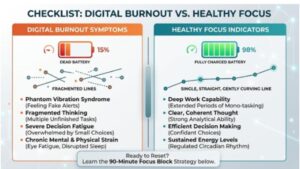
- The “Phantom Vibration” Syndrome: Feeling like your phone is buzzing in your pocket when it isn’t.
- Fragmented Thinking: Starting five different tasks but being unable to finish a single one.
- Decision Fatigue: Feeling completely overwhelmed by simple choices, like what to eat for dinner.
- Physical Strain: Chronic neck pain, eye strain, and a disrupted circadian rhythm.
If you find yourself constantly re-reading the same paragraph or struggling to form a coherent argument for a paper, you are likely in the middle of a focus crisis. During these moments, many students realize that the burden of complex research is too much to handle alone, leading them to buy expository essay drafts to see how professional evidence-linking should actually look, ensuring they have a solid foundation to build upon.
The Focus Reset Framework (Visual Guide)
To visualize how burnout affects your performance, consider the “Attention Economy Funnel.”
[Diagram: The Attention Economy Funnel]
- Top of Funnel (Input): 275+ Notifications, 7+ Hours of Screen Time, Endless Scroll.
- Middle (The Bottleneck): Prefrontal Cortex Overload, Spiked Cortisol, Decision Fatigue.
- Bottom (The Output): Fragmented Work, 47-second Attention Span, Burnout.
- The Reset Switch: Scheduled Disconnection & Systematic Offloading.
4. Step-by-Step Focus Reset Strategy
Resetting your focus is not about throwing your laptop in the ocean; it’s about creating sustainable digital boundaries. Here is how you can regulate your nervous system and reclaim your time.
I. The 90-Minute Focus Block
Human beings are not designed to work for eight hours straight. Our brains operate on “ultradian rhythms,” which are cycles of high-frequency brain activity followed by a period of lower activity. To work with your biology instead of against it, try the 90-minute rule. Work intensely for 90 minutes, then step away from all screens for 15 minutes. This allows your prefrontal cortex to “cool down” and prevents the buildup of sensory overwhelm.
II. Implement a “Dopamine Detox”
Social media is designed to give you small hits of dopamine every time you see a like or a new comment. Over time, your brain becomes desensitized to this, requiring more and more “scrolling” to feel normal. A dopamine detox involves a scheduled period—usually 24 hours—where you avoid all highly stimulating digital activities. By lowering the baseline of stimulation your brain expects, you make “boring” tasks like reading or deep research feel much easier to start.
III. Sensory Regulation and Physical Environment
Your environment dictates your focus. If your phone is on your desk, even face down, your brain is subconsciously thinking about it.
- Gray Scale Mode: Turn your phone screen to grayscale to remove the “tasty” colors that make apps addictive.
- The “Out of Sight” Rule: Put your devices in another room during deep work hours.
- Natural Light: Work near a window to help regulate your circadian rhythm and improve sleep quality.
IV. The Power of Structured Outsourcing
One of the biggest causes of digital burnout is trying to do everything yourself in a world where information is unlimited. High-performers know when to delegate. Whether it’s using a grocery delivery app or seeking professional help for a complex project, reducing your “cognitive load” is essential. When the technical requirements of a project become a source of anxiety, leveraging myassignmenthelp ensures that the structural and research-heavy aspects of your work are handled with precision, allowing you to focus on the big-picture ideas.
The Impact of 2026 Digital Trends
In 2026, the rise of AI-powered workflows has created a “productivity paradox.” While we can produce more, the pressure to keep up with machine-speed output has led to an 80% increase in global workers reporting a lack of energy. We are seeing a “crisis of focus” in universities where students accustomed to 15-second bursts of information struggle with deep reading.
Summary of Focus Recovery Metrics
| Category | Metric/Action | Impact on Focus |
| Screen Time | Limit to < 4 hours (non-work) | Restores Melatonin and Circadian Rhythm. |
| Interruption Cost | 23 Minute Refocus Time | Saves up to 3 hours of lost productivity daily. |
| Micro-Breaks | The 20-20-20 Rule | Reduces ocular fatigue and mental “fog.” |
| Tech Boundary | Digital Sunset (1 hr before bed) | Decreases morning cortisol spikes. |
| Delegation | Use myassignmenthelp for drafts | Reduces cognitive load by 40% on complex tasks. |
Redefining Your Relationship with Tech
As we move further into 2026, the divide between our physical and digital lives will only continue to shrink. Focus is the new currency. If you can protect your attention, you can achieve in two hours what others take ten hours to finish. Resetting your focus isn’t a one-time event; it’s a daily practice of choosing what deserves your energy.
Start small: leave your phone in another room tonight during dinner. Notice the silence. That silence is where your best ideas are hiding. Digital burnout is avoidable, but it requires the courage to disconnect so that you can reconnect with what actually matters. By treating your attention as a limited resource, you stop being a victim of the “attention economy” and start being the architect of your own productivity.
Frequently Asked Questions
What are the first signs of digital burnout?
Early indicators often include persistent mental fatigue, a fragmented attention span, and feeling overwhelmed by simple daily decisions. You might also notice physical symptoms like eye strain, disrupted sleep patterns, or a constant urge to check your devices even when there are no new notifications.
How long does it take to reset your mental focus?
While a quick 15-minute screen-free break can provide immediate relief, a full cognitive reset typically requires 24 to 48 hours of significantly reduced digital stimulation. This allows your nervous system to regulate and lowers the baseline of dopamine your brain expects from constant scrolling.
What is the most effective way to manage screen time at home?
The most successful strategy is “environmental design,” which involves creating physical boundaries between yourself and your devices. Placing your phone in a different room during deep work or meals and establishing a “digital sunset” one hour before bed are highly effective ways to reclaim your attention.
Can natural light really improve productivity?
Yes. Exposure to natural light helps regulate your internal clock, which controls your sleep-wake cycle and cortisol levels. By working near a window, you can improve your mood and energy levels, making it easier to maintain concentration throughout the day without relying on caffeine or digital stimulation.
About The Author
Oliver Smith is a dedicated educational consultant and senior content strategist at myassignmenthelp. With a background in academic research and professional development, he focuses on creating clear, impactful resources that help students and professionals navigate the complexities of modern learning.